
Search
Professionals
26-04-08
According to an analysis by the Ministry of Intellectual Property (MOIP, formerly KIPO), patent applications in the field of ferroelectric devices filed with the IP5 offices (Korea, the United States, Japan, the European Union, and China) between 2012 and 2023 show that Korea ranked first, accounting for 43.1% (395 cases) of the total filings based on applicant nationality. In particular, Korea also recorded the highest average annual growth rate of 18.7% in filings, marking the steepest increase among major countries and indicating its growing leadership in next-generation artificial intelligence memory technologies.
Ferroelectric materials are dielectric materials that retain spontaneous polarization even in the absence of an external electric field. Due to this property, they enable both non-volatility and ultra-fast response speeds. Devices based on ferroelectric materials offer the advantage of compatibility with existing semiconductor fabrication processes and infrastructure, allowing for immediate mass production without the need for significant new investments. In addition, ferroelectric devices maintain stable physical properties even in ultra-thin films at the nanometer (nm) scale, making them key materials for overcoming the miniaturization limits faced by conventional dielectrics in advanced semiconductor technologies.
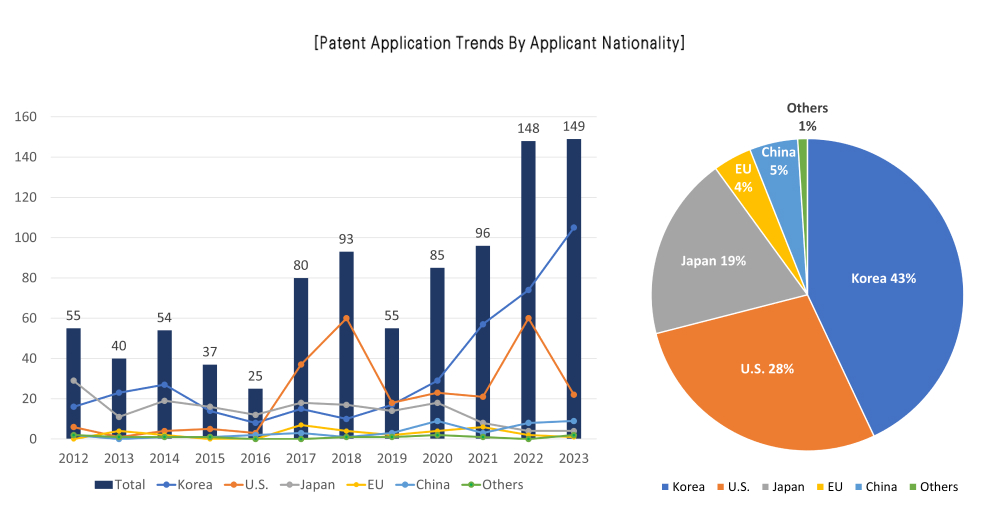
A closer examination of the patent application data shows that, by applicant nationality, Korea held the largest share at 43.1% (395 cases), followed by the United States at 28.4% (260 cases), Japan at 18.5% (170 cases), China at 4.6% (42 cases), and the European Union at 4.1% (38 cases). Over the same period, Korea also recorded the highest average annual growth rate at 18.7%, followed by China (14.7%) and the United States (12.5%), while the European Union (5.8%) and Japan (-19.8%) posted growth rates well below, or, in Japan’s case, a decline relative to, the overall average of 9.5% among major countries.
Among major applicants, Samsung Electronics (Korea) ranked first with 27.8% (255 cases), followed by Intel (United States) at 21.0% (193 cases), SK Hynix (Korea) at 13.4% (123 cases), TSMC (Taiwan) at 10.1% (93 cases), and Nanya (Taiwan) at 5.3% (49 cases). Notably, during the most recent three-year period (2021–2023), Samsung Electronics (139 cases) and SK Hynix (86 cases) ranked first and second, respectively, Underscoring in global research and development on ferroelectric devices for AI memory.
As Korean companies continue to build strong patent portfolios in this field and advance toward commercialization, global semiconductor players may need to proactively strengthen their patent portfolios in the Korean market. This could help secure bargaining power in potential cross-licensing negotiations or, alternatively, enable them to target technological niches by preempting patents in back-end processes (e.g., advanced packaging) and application areas.
 SHARE
SHARE

 Go to List page