
Search
Professionals
26-11-02
1. Criteria Applied by Korean Courts in Assessing Novelty and Inventive Step of Compound Selection Inventions
For compound selection inventions involving specific compounds (species) selected from a broader class of compounds (genus) disclosed in a prior art reference, Korean courts apply the following criteria in assessing novelty and inventive step:
(1) Criteria for Assessing Novelty
A compound selection invention lacks novelty if the selected species is specifically disclosed in a prior art reference. Such disclosure includes cases where the selected species is expressly disclosed in the reference, as well as cases where one of ordinary skill in the art could directly recognize the selected species from the disclosure of the reference in light of common technical knowledge at the time of filing (see Supreme Court Case No. 2005 Hu 3338, issued on September 6, 2007; and Supreme Court Case Nos. 2008 Hu 736 and 2008 Hu 743, issued on October 15, 2009).
(2) Criteria for Assessing Inventive Step
Even where a prior art reference discloses a genus encompassing the claimed invention, the claimed invention may nevertheless be determined to have an inventive step if there is technical difficulty in conceiving the invention. In assessing the inventive step of a selection invention, the technical difficulty in conceiving the invention must therefore be taken into account. In determining whether such technical difficulty exists, the following factors should be considered collectively: (i) the number of compounds that can theoretically be encompassed by the chemical formula and substituents in the Markush groups disclosed in the reference; (ii) whether the reference provides any circumstances, motivations, or suggestions that would lead one of ordinary skill in the art to preferentially or readily select a particular compound or particular substituents from among the compounds in the Markush groups disclosed in the reference; and (iii) the degree of structural similarity between the compounds specifically disclosed in the reference and the claimed compound.
In assessing the inventive step of a selection invention, the distinctive technical effects of the invention must also be considered. Even where the technical difficulty of conceiving the invention is unclear, inventive step may nevertheless be acknowledged if the invention produces a qualitatively different effect or a quantitatively superior effect compared with the compounds disclosed in the prior art reference. Superiority of such effect should be assessed primarily based on the effect that one of ordinary skill in the art could recognize or reasonably infer from the specification. Where the asserted effects are in doubt, the applicant may submit additional post-filing data to substantiate them, provided that such data does not go beyond the scope of disclosure in the specification (see Supreme Court Case No. 2019 Hu 10609, issued on April 8, 2021).
2. Supreme Court Case No. 2024 Hu 10979 (issued on March 12, 2026)
In Supreme Court Case No. 2024 Hu 10979, the Korean Supreme Court reaffirmed the principles established in its earlier decisions concerning the novelty and inventive step of compound selection inventions.
This case arose from an invalidation trial involving Korean Patent No. 2094830, entitled “Polycyclic Aromatic Derivative Compound and Organic Light-Emitting Device Using the Same,” in which the patent was challenged on the grounds of lack of novelty, lack of inventive step, and insufficient disclosure. The Intellectual Property Trial and Appeal Board (IPTAB) found that the claimed invention lacked an inventive step and issued a decision invalidating the patent. However, the Intellectual Property High Court (IPHC) reversed the IPTAB’s decision on the grounds discussed below, and the Supreme Court upheld the IPHC’s judgment.
General Formula (1) (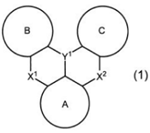 ) is disclosed in a prior art
reference, whereas Formula A-3 (
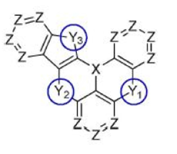 ) is disclosed in Korean Patent No.
2094830. Formula A-3 has a structure in
which a five-membered ring is first fused at the B-ring position of General
Formula (1), with a six-membered benzene ring further fused to that
five-membered ring (
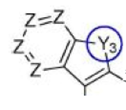 ).
Although Formula A-3 of the patented invention falls within General
Formula (1) of the reference, the specification and examples of the reference specifically
disclose only compounds having a six-membered ring at the B-ring position.
With respect to novelty, the IPHC held that, because the reference did not specifically disclose a compound having a five-membered ring and a six-membered ring fused at the B-ring position of General Formula (1), the claimed compound could not be directly recognized from the reference. Accordingly, the IPHC found that the patented invention was novel, and the Supreme Court upheld this determination.
With respect to inventive step, the IPHC found that the patented invention has an inventive step based on the following considerations:
(i)Deriving Formula
A-3 from General Formula (1) disclosed in the reference would require first selecting,
from among the compounds represented by General Formula (1), a structure in
which a five-membered ring is first fused to the fused bicyclic structure at
the B-ring position, with a six-membered benzene ring further fused to the
five-membered ring (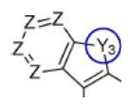 ), and then selecting a specific
combination of substituents X, Y1, Y2, and Y3.
Thus, Formula A-3 corresponds to the
selection of a compound having a specific chemical structure from among
numerous compounds theoretically encompassed by the reference;
(ii)The reference provides no motivation or suggestion that would lead one of ordinary skill in the art to preferentially select the compound of Formula A-3 from among the compounds in the Markush groups disclosed in the reference;
(iii)The reference specifically discloses only compounds in which the A, B, and C rings of General Formula (1) are six-membered benzene rings or structures in which additional rings are fused to those rings. Accordingly, the compound of the patented invention cannot be regarded as structurally similar to the compounds specifically disclosed in the reference; and
(iv)The patented invention produces remarkably superior or improved external quantum efficiency and operational lifetime characteristics compared with the compounds disclosed in the reference.
The Supreme Court upheld the IPHC’s determination that the patented invention had an inventive step.
3. Implications
In Supreme Court Case No. 2024 Hu 10979, the Supreme Court reaffirmed the established legal principles governing compound selection inventions, confirming that the mere fact that a claimed compound falls within a Markush-type generic formula disclosed in the prior art reference does not, by itself, necessarily negate novelty or inventive step.
In this case, the courts upheld the validity of the patent after comprehensively considering the specific compounds disclosed in the prior art reference, whether there was any motivation or suggestion to preferentially select the claimed compound, the degree of structural similarity between the claimed compound and those specifically disclosed in the prior art reference, and the technical effects achieved by the patented invention.
This decision is significant in reaffirming that, when assessing the patentability of selection inventions in the field of chemical materials in Korea, greater importance may be placed not merely on whether the selection invention is encompassed by a broad generic formula disclosed in the prior art reference, but rather on the specific disclosure of the prior art reference, the technical difficulty of arriving at the selected chemical structure, and the demonstrated technical effect.
 SHARE



 Go to List page