Under the Korean Trademark Act (KTA), a mark that is identical or similar to a trademark recognized by consumers as an indication of the source of a specific person or legal entity, whether in Korea or abroad, and that is filed in bad faith to obtain any unfair profit or to cause harm, cannot be registered (Article 34(1)(xiii) of the KTA). In the recent IP High Court decision (Case No. 2025heo10296), the applicant submitted trademark awareness survey results in an attempt to deny consumer recognition of the prior-used marks. However, the Court instead treated the survey results as supporting evidence that the prior-used marks were, in fact, recognized by consumers as source identifiers.
Factual Background
The plaintiff in this case received a final refusal on the grounds that its applied-for mark “

” fell under Article 34(1)(xiii) in relation to the prior-used marks “

”, “

”, and “

.” The plaintiff appealed to the Intellectual Property Trial and Appeal Board (IPTAB), but the appeal was dismissed. In the subsequent appeal to the IP High Court, the plaintiff submitted
a trademark awareness survey allegedly showing low recognition of the prior-used marks. The key results were:
- Total respondents: 1,011
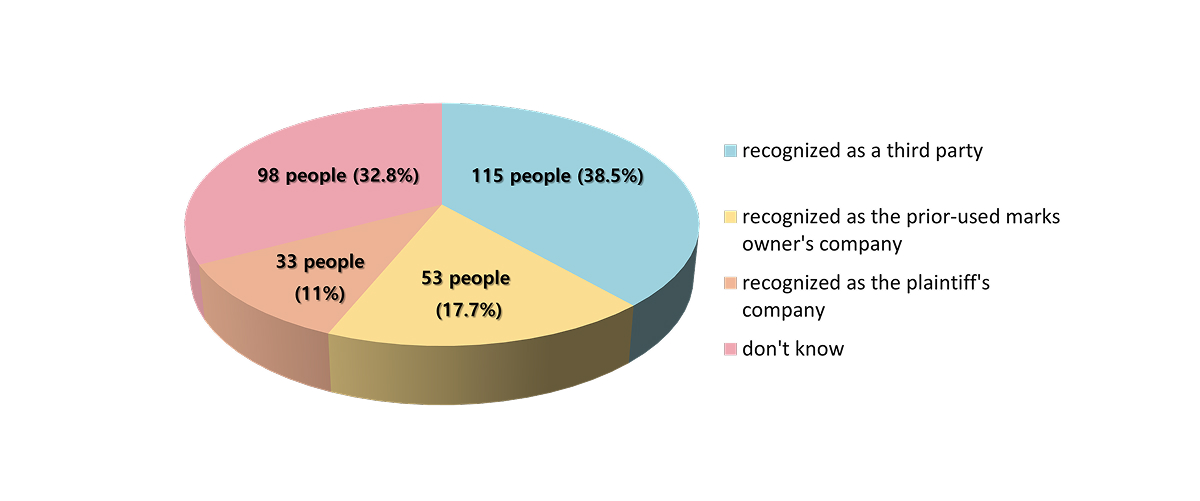
- 299 out of 1,011 respondents (29.6%) had heard of or seen the prior-used marks
- 53 out of 299 respondents, who had heard or seen the prior-used marks, recognized the marks as prior-used marks, as shown below:
Court’s Findings
The IP High Court held that it is not necessary for consumers to know the name of the rights holder. What matters is whether the mark is recognized as indicating a specific source, even if the exact entity is not known. The Court found that an approximately 30% awareness rate (“have heard or seen”) could serve as evidence that the prior-used marks were recognized as indicating the sources of a specific person/legal entity.
The Court further found bad faith, taking into account: (i) the similarity of the marks and goods; (ii) the plaintiff’s history of filing multiple related trademarks— including one previously refused after referencing a name made famous by a popular television program, suggesting the plaintiff likely checked for similar marks prior to filing; and (iii) the fact that the prior-used marks were recognized as source identifiers.
Significance of the Decision
This decision is notable for two main reasons:
(1) Survey evidence can backfire.
Awareness survey results submitted to deny consumer recognition may instead be used as favorable evidence for the opposing party.
(2) A 30% awareness rate may be sufficient.
A recognition rate of approximately 30% (for “have heard of or seen”) may serve as a basis for finding that a mark functions as a source identifier.
The plaintiff has appealed to the Supreme Court, so the final determination on these issues will depend on the Supreme Court’s ruling.
Practical Application Tip
Recent judicial practice shows an increasing reliance on trademark awareness surveys. Therefore, depending on the circumstances, conducting such surveys may be strategically valuable.
As this case demonstrates, even a recognition rate of 30% may be treated as supporting evidence that a mark is perceived as a source identifier. Therefore, when preparing awareness surveys, it is essential to carefully design questions, select appropriate sample groups, and establish clear evaluation criteria, to ensure that the results accurately reflect consumer perception and effectively support the intended argument.



 SHARE
SHARE
 Go to List page